Caste system
Brave New WorldThe World State caste system is a biological and ideological hierarchy: people are produced for different ranks, conditioned to accept their assigned place, and taught to regard the resulting inequalities as ordinary. Its defining logic is that social order depends not on making everyone alike in ability, but on manufacturing distinct groups whose capacities and expectations suit their allotted work.
Production and Predestination
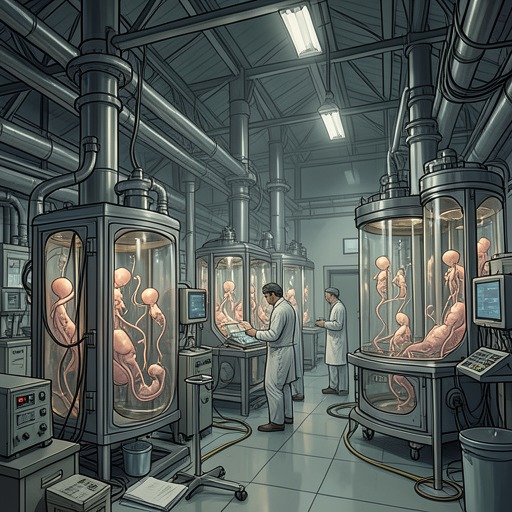
The system begins with the deliberate multiplication of embryos. Under the Bokanovsky process, a single egg can divide into as many as ninety-six buds, each developing into a human being; seventy-two is described as a good average. The process is presented as one of the major instruments of social stability because it supplies uniform batches of people, potentially allowing a small factory to be staffed by the products of one egg.
Mass production is coordinated with the demand to stabilize the population in the present. By accelerating the maturation of eggs, the authorities can obtain at least 150 mature eggs within two years and, at an average multiplication of seventy-two, produce nearly 11,000 same-age siblings in 150 batches. The stated ambition is not simply to reproduce life, but to synchronize and scale it for social planning.
Predestination continues inside the embryo bottle. The system labels embryos by sex and regulates development, including by giving many female embryos male sex hormones so that they will be sterile. The Director describes the aim as producing people already fitted to their future rank and occupation: from Alphas to Epsilons, and from future sewage workers to future administrators. Reproduction and job allocation are therefore joined at the outset rather than treated as separate stages of life.
Biological Differentiation
Development is adjusted to match the expected environment of each caste. As a Beta-Minus mechanic reduces the speed of a blood-surrogate pump, less oxygen reaches the embryo. The Director explains that lower castes receive less oxygen, affecting the brain first and the skeleton afterward; severe restriction can produce dwarfs or, below seventy per cent of normal oxygen, embryos considered unusable. The system thus makes bodily capacity an instrument of occupational allocation.
This engineered difference is framed as consistency between heredity and environment: an Epsilon embryo, the Director insists, must have an Epsilon environment as well as Epsilon heredity. Rather than treating diminished capacity as an obstacle to overcome, the state manufactures it to match a predetermined social role. The technique makes hierarchy appear to be rooted in the body, while that bodily distinction is itself the result of deliberate policy.
Lessons in Hierarchy
Biological ranking is reinforced by education that makes caste identity feel like common sense. A recorded lesson teaches children to identify groups by their clothing and to prefer their own rank: Alphas wear grey, Gammas green, Deltas khaki, and Epsilons black. The lesson praises the greater intelligence and heavier work attributed to Alphas while reassuring Betas that they are fortunate not to work as hard. Other ranks are dismissed as inferior, and the child’s stated preference for being a Beta presents the hierarchy as a personal judgment rather than an imposed structure.
The Director explains that these suggestions become part of a child’s mind through repetition, shaping adult judgment, desire, and decision as well as childhood opinion. The image is not of a single command but of lessons that accumulate until they seem inseparable from the person who has learned them. In this way, social conditioning supplies consent to a structure already established through biological production.
The same method carries caste values into consumption. Children are taught to enjoy flying and new clothes, and to reject old clothes because they should be thrown away rather than mended. The lesson connects social formation to industrial demand: citizens are trained not only to accept their rank but also to desire the habits that keep the economy moving. The caste system consequently governs both the distribution of work and the formation of everyday preferences.
Stability and Its Costs
The system’s claims are challenged when John recalls the rows of identical people and asks why the authorities do not make everyone an Alpha Double Plus. Mustapha Mond answers that a society composed entirely of Alphas would be unstable and miserable: individuals with good heredity, independence, and the capacity to make choices and assume responsibility would not fit the uniform organization of factory life. His response makes the hierarchy’s governing trade-off explicit. Different ranks are maintained not because equality is technically impossible, but because the state regards differentiated capacities as necessary to its preferred order.
John’s question also gives the system a human consequence beyond its administrative rationale. He sees the repeated faces and uniform groups as disturbing, while Mond describes those groups as the foundation and stabilizing mechanism of the state. Their contrast exposes the cost of treating people as interchangeable units: stability is secured by restricting the range of lives the society permits them to lead.
The caste system reaches beyond the World State’s laboratories into John’s experience in Malpais. At fifteen, he learns to work clay with Mitsima, finding pleasure in acquiring a skill through practice; at sixteen, he is rejected from the Antelope Kiva ceremony because of his identity and left outside the community. These experiences do not describe the World State’s caste machinery, but they sharpen the distinction between assigned social categories and lived belonging. Across the novel, rank is shown both as an engineered structure that makes inequality seem natural and as a social boundary whose human consequences cannot be reduced to orderly production.